
Well pump repair in Jacksonville gets water flowing again in homes on private wells. The usual culprits are a failed pump or motor, a bad pressure switch, a waterlogged pressure tank, a tripped breaker or control box problem, or a leak in the line between the well and the house. A plumber tests each part to find the one that failed instead of replacing the whole system.
Well water pump repair
Most homes in the Jacksonville area with private wells use either a submersible pump down in the well or a jet pump above ground. Submersibles are more common for deeper wells and are quieter; jet pumps are often found on shallower wells and older systems. Both push water into a pressure tank, and a pressure switch turns the pump on and off.
Pump and motor
Worn motors, failed capacitors, burnt wiring and pumps clogged with sand. Submersible pumps have to be pulled from the well to replace.
Controls
Pressure switches with burnt or pitted contacts, failed control boxes and tripped breakers are frequent and inexpensive fixes.
Lines
A leak between the well and the house makes the pump run constantly and pressure drop. Sand and air in the water are clues too.
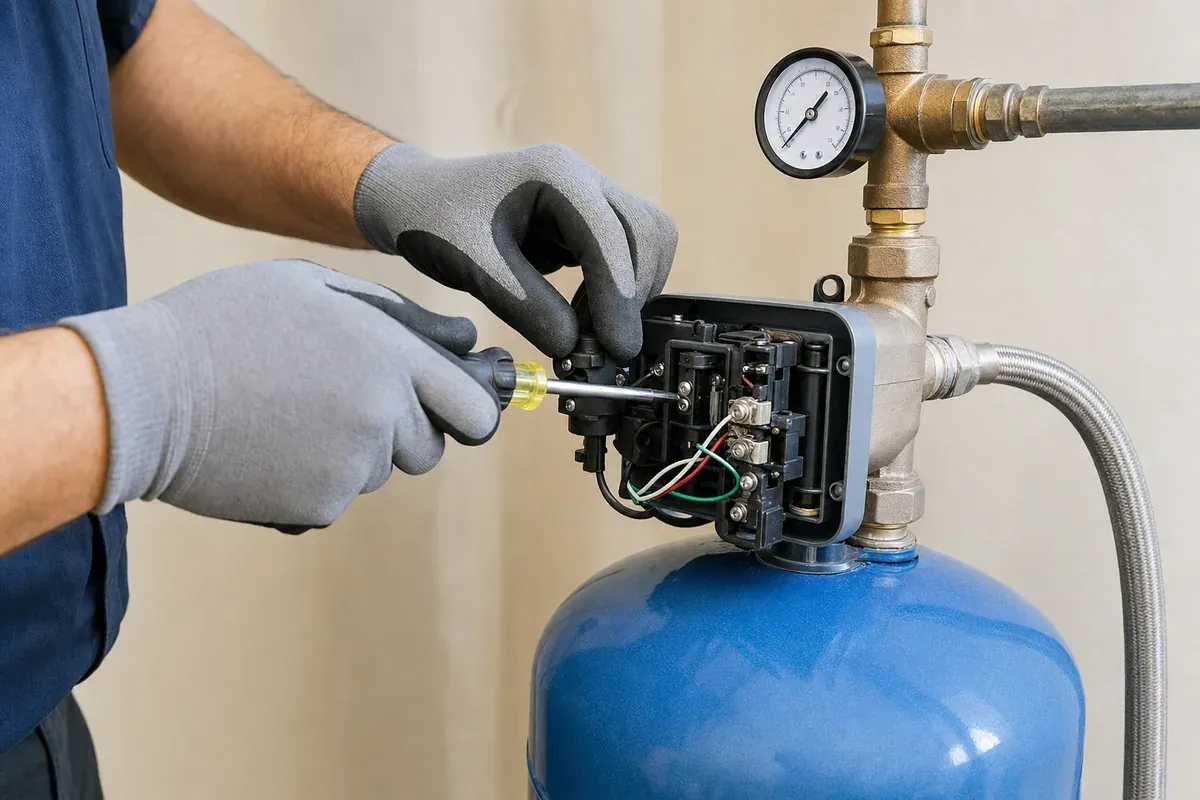
Pressure tank repair & replacement
The pressure tank stores water under pressure so the pump doesn't have to start every time you open a faucet. Inside most modern tanks is a bladder or diaphragm with an air charge on one side. When the bladder fails or the air charge is lost, the tank becomes waterlogged and the pump short-cycles, turning on and off rapidly. Short-cycling burns out pumps and switches early.
- Pressure that surges and drops while a faucet runs
- The pump clicking on and off every few seconds
- Water coming out of the air valve on top of the tank
- A tank that sounds or feels full of water all the way to the top
- Rust or leaks around the tank base
Sometimes the air charge just needs to be reset. If the bladder has failed, the tank is replaced. Sizing the new tank correctly reduces how often the pump has to start.
Low pressure / no water troubleshooting
Before you call, a few safe checks can save time:
- Check the breaker for the well pump in your electrical panel. If it's tripped and trips again when reset, stop and call.
- Look at the pressure gauge on the tank. Near zero with the pump not running points to the pump, switch or electrical supply.
- Check filters. A clogged sediment or whole-house filter can make it look like the well has failed.
- Listen at the tank. A pump that runs and runs without building pressure may have a leak, a lost prime on a jet pump or a failing pump.
After a power outage or a lightning storm, pump controls and pressure switches are common casualties. Northeast Florida's summer storms see to that.
Wells in North Jacksonville, Nassau & Clay County
Private wells are most common on larger lots in the outer parts of the Northside and Westside, in Nassau County outside the city water areas, in rural Clay County and parts of St. Johns County. Most draw from the surficial aquifer or the deeper Floridan aquifer. Floridan water is typically hard and often has a sulfur smell, which is why many well homes pair the well with a water filtration system. Homes with a well usually have septic too, so see our septic services page if you're on both. We cover these areas across North Jacksonville and South Jacksonville.
Low lot that floods in storms? A sump pump moves standing water away from the house.
What affects the cost
- What failed. A pressure switch or capacitor is a small repair compared with a pump replacement.
- Pump type and depth. Pulling a submersible pump from a deep well takes more time and equipment.
- Tank size. Pressure tanks vary widely in size and price.
- After-hours calls. No-water emergencies at night or on weekends may cost more.
Well pump repair across Jacksonville
Well pump repair FAQ
Why does my well pump keep turning on and off?
Rapid cycling, called short-cycling, usually means the pressure tank is waterlogged or has lost its air charge, or the pressure switch is failing. It wears out the pump quickly, so get it checked.
How long do well pumps last?
Many submersible well pumps last around 10 to 15 years, depending on water quality, sand, how hard the pump works and whether the pressure tank is healthy.
Why do I have no water from my well?
Common causes are a tripped breaker, a failed pressure switch, a burnt-out pump or motor, a broken line from the well, or a lost prime on a jet pump.
Can a pressure tank be repaired?
If the air charge is low, it can often be recharged. If the bladder inside has failed and the tank is waterlogged, the tank is replaced.
Why does my well water smell like rotten eggs?
That's usually hydrogen sulfide, common in Floridan aquifer water around Jacksonville. Water treatment systems can remove it. See our guide to Jacksonville water quality.