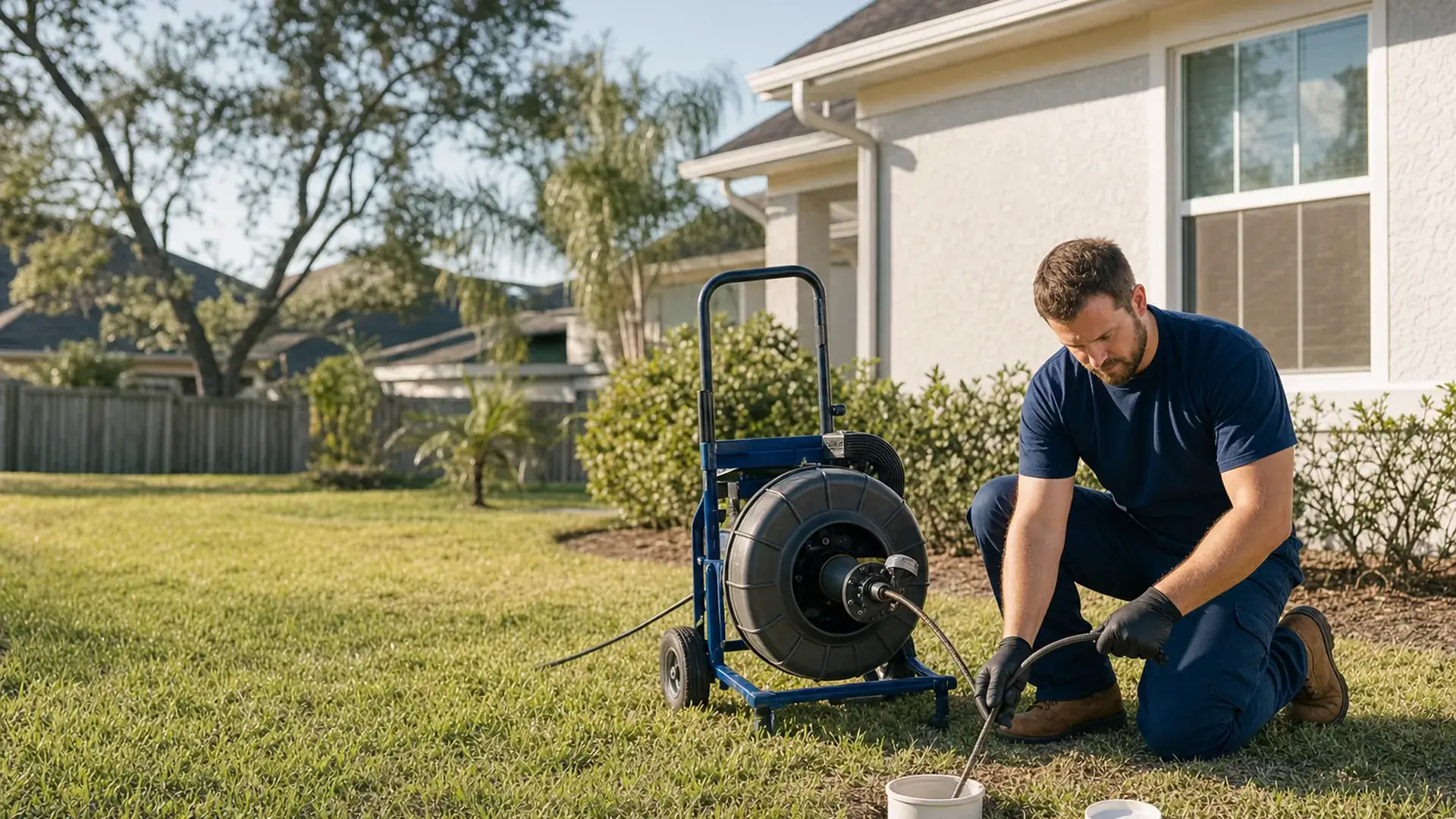
Drain and sewer services cover everything that carries wastewater out of your home: the fixture drains, the main building drain and the sewer lateral that runs to the city sewer or your septic tank. In Jacksonville that usually means clearing clogs, cleaning lines with high-pressure water, inspecting pipes with a camera and repairing or replacing sections that have cracked, sagged or filled with roots.
Drain cleaning
Most calls start here. A kitchen sink full of grease, a shower slowed by hair, or a toilet that won't clear are local clogs that a plumber can usually fix in one visit with a drain snake. When several drains back up together, the problem is in the main line, and clearing it takes a larger machine run from a cleanout in the yard or by the house. Read more about drain cleaning in Jacksonville.
Hydro jetting
Hydro jetting sends water at very high pressure through the line with a nozzle that scours the pipe wall. It removes grease, scale and roots that a cable just pokes a hole through, which makes it the better choice for restaurants, older homes with heavy buildup and lines that clog every few months. A plumber should check the pipe's condition first, because brittle cast iron, clay or Orangeburg pipe can be damaged by the pressure. See hydro jetting.
Camera inspection
A waterproof camera on a flexible push rod travels down the line and shows exactly what's inside: roots at a joint, a belly where the pipe has sunk, an offset where two sections have shifted, or a crack. Many sewer cameras also have a locator so the plumber can mark the problem's location and depth on the ground, which keeps digging to a minimum. Inspections are also popular with home buyers before closing. Learn about sewer camera inspection.

Sewer line repair & replacement
When the camera shows real damage, there are usually a few ways to fix it. A single broken joint can often be dug up and replaced with PVC as a spot repair. Longer runs of failing pipe may be replaced with an open trench, or, where access allows, rehabilitated with trenchless methods such as pipe lining or pipe bursting that avoid tearing up the driveway or landscaping. The right option depends on the pipe material, depth, damage and what's on top of it. More on sewer line repair.

Signs of sewer line problems
The main line usually gives warnings before it fails completely. Watch for:
- Several drains slowing down or backing up at the same time
- Gurgling from toilets or drains when another fixture runs
- Water coming up in the shower or tub when the washer drains
- Sewage smell inside or around the yard cleanout
- Unusually green, soggy or sunken patches of lawn over the sewer line
- Repeat clogs in the same line within weeks of clearing
Our guide to the signs of sewer line problems goes into each one in more detail.
Why Jacksonville sewer lines fail
Housing age matters. Homes built before about 1975 in neighborhoods like Riverside, Avondale, Springfield, Ortega, San Marco and Murray Hill often have cast iron or vitrified clay sewer laterals. Cast iron corrodes from the inside, and clay joints let in the roots of the live oaks and laurel oaks that shade those streets. Some homes from the 1950s and 1960s have Orangeburg pipe, a tar paper pipe that deforms and collapses with age.
Sandy soil and a high water table add their own problems. Pipes settle over time and develop low spots that collect waste, and at the Beaches and along the river there's very little fall for a sewer line to work with. Newer homes in Mandarin, Southside, Nocatee and Fleming Island mostly have PVC, so clogs there are more often grease, wipes and construction debris than broken pipe.
What affects the cost
- The job. Clearing a clog is a different price from a camera inspection, and both are far less than replacing pipe.
- Access. An accessible cleanout keeps costs down. Pulling a toilet or working through a roof vent adds time.
- Depth and what's on top. A sewer line under a driveway, slab or mature tree costs more to repair than one under open lawn.
- Permits. Sewer line replacement usually requires a permit and inspection.
The plumber explains the options and the price before any work starts.
Drain and sewer services across Jacksonville
Drain & sewer FAQ
Who is responsible for the sewer line in Jacksonville, me or the city?
Generally the homeowner owns and maintains the sewer lateral from the house to the property line or the utility's cleanout, and the utility handles the main in the street. Check with your sewer provider, such as JEA, for the exact dividing point on your property.
How do I know if a clog is in the main line?
If more than one fixture is affected, especially the lowest drains in the house, or if water comes up in the tub when you flush or run the washer, the clog is almost certainly in the main line.
Can tree roots really break a sewer pipe?
Roots enter through tiny cracks and loose joints looking for water, then grow and widen the gap. Over time they can crack or completely block older clay and cast iron pipe.
Is trenchless sewer repair available in Jacksonville?
Yes, for many lines. Whether it suits your home depends on the pipe's condition, size, layout and access points, which a camera inspection will show.
How often should a sewer line be cleaned?
Most homes never need routine cleaning. If roots or grease keep returning, cleaning every one to two years, or a permanent repair, prevents emergency backups.